Serbia is just starting to work on Natura 2000. There is a hard work ahead of us, above all finding finances
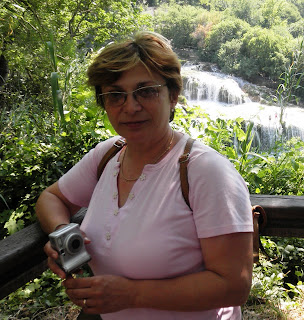
The director of Institute for Nature Conservation of Vojvodina Province, Ph.D. Biljana Panjkovic will take care of the process of implementation of Natura 2000 in Serbia. We have talked in a relaxed atmosphere of National park Krka in Croatia, where Biljana came with Serbian and Montenegrin colleagues for a study tour of “Partnership Actions for Biodiversity Protection in Western Balkans” project.
As I hear, you’re the top expert for Natura 2000 in Serbia!
Well, maybe I’m not that much a top expert… But as we are in the process of pre-accession to the European Union, we have condition to implement Natura 2000 to become a member state. Since we’re already late in comparison with the other countries from the region, Ministry of Environment, Mining and Spatial Planning formed the working group to make an action plan and to coordinate all activities to implement Natura 2000 in Serbia. I am the head of that working group that consists of experts who are considered to be relevant to Natura 2000: experts in the field of ornithology, habitats, species... They will form their own teams with the experts and scientists they find most relevant, and the persons who will map their results. We think that there should be involved all academic institutions, professional institutions, NGOs, various individuals… all the people that have data on species and habitats. This project starts this year, which includes preparatory phase, but most of the work refers to the period of 2012-2015, when the mapping of habitats and species is planned, as well as the checking of existing data. After that preliminary list will be prepared and send to the European Commission for negotiations.
Have you already started to work?
We have started! The working group was formed, as well as the Council. We are developing the action plan that has to be adopted, and then we need to go full speed ahead if we want to have a result – and we want that! We also have a great support of our Ministry and the Government of the Republic of Serbia. There have been several projects related to the mapping of habitats and species, and those related to certain protected areas such as Special Nature Reserve Zasavica. Currently, there is a Twinning project in collaboration with the Austrian Agency for Environmental Protection. It is a consulting service; they estimate the state of nature and raise the capacity of administrations and NGOs that are recognized for their performance in the field of nature protection. First results have already been achieved on the basis of current knowledge; we have identified potential areas of special protection for birds and migratory species (SPA). The transfer of experience is helpful, but it is still related to a small number of people. We have used the recommendations from the Twinning project as a basis for drafting an action plan on establishing Natura 2000 in Serbia. We have planned about ten years to work on Natura 2000. In the fifth, sixth year we might have a preliminary list of areas. At that time we should start working on a variety of manuals for monitoring and management. Actually, we don’t have any manuals for species and habitats, this is the first thing we need to do.
There would be some manuals still this year thanks to the project “Partnership Actions for Biodiversity Protection in Western Balkan”!
That’s great! We will use them, as well as we use brochures prepared by the State Institute for Nature Protection in Croatia and their book on habitats. Of course, we have our own specific habitats and species and we need to take care which of them shall be included in the list…
Do you have any idea how much of Serbia would be protected through the Natura 2000 network?
Well, since the Institute for Nature Conservation is responsible for nature protection of Vojvodina province, I can tell you only the data for Vojvodina. 5.98% of the area is under protection in Vojvodina. What is foreseen for protection, including those areas that are in the audit assessment of natural values for which protection has been established, there won’t be more than 11% protected. If we add to this figure habitats that were identified - some 520 habitats - we get another 6.5%. Therefore, in Vojvodina there can’t be more than 17,5% of ecological network. In the whole Serbia that percentage should be higher. 5,96% of Serbia is protected, and that is little. Some studies are completed and they say it will be 8.3% by 2012. Therefore, for the whole of Serbia, it could be over 30%. There are many mountainous areas that are abandoned, people have gone to the cities, there are no many villages, and they have small population so it should all fit ... But all this requires a lot of field work, and not just a question of how much per cent will be protected, but what kind of protection it would be. We will have to establish a monitoring to keep track of whether it's good and what needs to be changed.
Do you expect any difficulties in this process?
Of course, first of all I expect difficulties with finances. We have some modest funds that the state has set aside for this year, but we should try to apply for various funds. The state would have to provide a part of necessary funds as well as the minimum 15% participation, in funds. Natura is the national interest and I expect help from all. All those who have information are welcome. In Serbia, Emerald network is established and the establishment of a national ecological network is also in progress. To make the proper proposal of some site and to implement Natura 2000, we need to include all state areas and consider it as a whole. The obtained data have multiple purposes, not only for Natura, but also to establish a monitoring. In my knowledge, last detailed surveys of vegetation in Serbia, which are crucial for habitats mapping, were done in 1980's and weren't completely finished. Realistic assessment of the situation brings us tangible savings in future years.
What shall be the role of NGOs in the process of designation of Natura 2000 sites?
Many non-governmental organizations are engaged in scientific research, especially ornithological organizations. More or less all the data related to birds can be found with them. So without their participation we can’t do anything. There are NGOs that work with habitat mapping and data. We also have a student society that, with very little training, can do mapping. I count on all of them! Many scientific professionals work on another projects that must be completed first, but there are many biologists who have no work at the time. I believe they would gladly join us with just a little training.
Are you in touch with colleagues from Slovenia and Croatia?
Institute for Nature Conservation of Vojvodina Province is in contact with the State Institute for Nature Protection in Croatia. Their team was in visit at the Institute for Nature Protection of Serbia in Belgrade where we met. I hope to develop close cooperation with them. They can’t disclose details, but we can sure use their methodology. We are also familiar with the experiences of our colleagues from Hungary. We can certainly use examples of good practice from our neighbour countries.
As far as I know, you don’t even have directives translated into Serbian...
I don’t know that, but certainly, if we don’t have that, directives need to be translated. We have formed a group that is engaged in writing projects. Some people from the ministry shall become part of that group. In the group there would be project managers who will know when some project occurs and when the applications should be sent. I hope that this team of people will apply on time for these funds.
Do you have an idea what shall be added to the annexes of directives of Serbian endemic species?
At this point I couldn't say something like that. In any case, it will be something that is characteristic only for us.
Petra Boic Petrac, WWF


 competitive, but I see many of them caring about each other which makes me proud of our two partners.